
Ascension du mont Aigoual par la voie de découverte
From Prat Peyrot, you take a magnificent, gently sloping country lane.
All along the circuit, enjoy the views. Rest for a moment at the summit, near the weather station. The panorama is exceptional. Then return to Prat Peyrot without any hurry.
23 points of interest
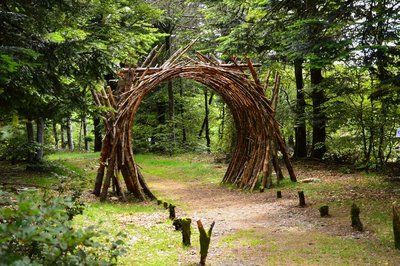
L'Orée (Yoann Crépin) - © Filature du Mazel 
On the Verge (Yoann Crépin)
A doorway to a circuit of art within the natural environment.
To fuse and interact with the environment and play with the seasons, time, light and weightlessness. To let humanity express itself through nature and nature express itself through humanity – a necessary interaction, a symbiotic interaction that inspires us to discover another world.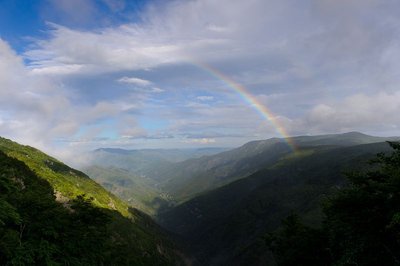
Vue plongeante sur la vallée de l'Hérault - Arnaud.Bouissou 
River capture
Violent precipitation and the steep gradient of Mediterranean torrents cause regressive (i.e. upstream) erosion of the valleys through which they flow. This erosion can invert the sense of flow and thus “capture” for the Mediterranean a waterway that had, until then, flowed into the Atlantic. One example is the Hérault with its waterfalls, the capture being located at the falls. The Hérault and the Dauphine brook used to flow via L'Espérou into the Dourbie... River pebbles found around the village by geologists attest to the existence of a waterway in the past.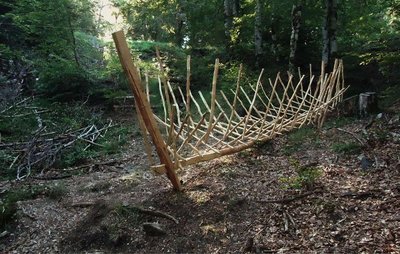
Bassin versant (Xavier Réche) - © Filature du Mazel Catchment Area (Xavier Rèche)
By its location and name, this installation evokes the nearby watershed between the Atlantic and Mediterranean. A vessel reduced to a suspended wooden framework, without strakes or gunwale, tilts in the direction of the runoff. It emphasises the first branches of a gigantic drainage system.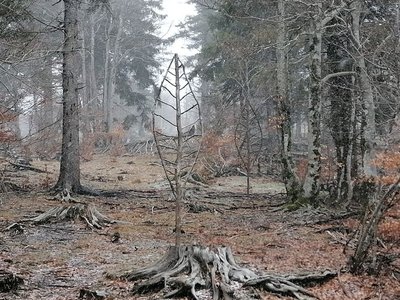
Arbre feuille (Alain Bernegger) - © Filature du Mazel  Flora
FloraLeaf-Tree (Alain Bernegger)
Leaf-Trees use a veined structure to create a visual resonance between the tree and the leaf. The change of scale works like an inverted echo of this fractal structure. And as winter comes, the eternal summer of the Leaf-Trees confronts the winter of the bare branches.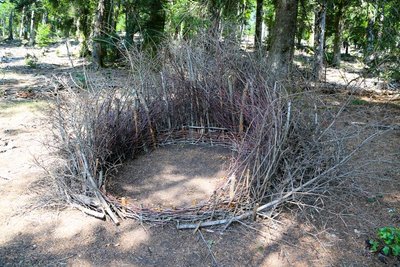
Nids (Céline Pialot) - © E. Fréget  Fauna
FaunaThe Nests (Céline Pialot)
Little by little, the bird makes its nest, its cosy nest, baby cocoon, wasps’ nest…
Like a bird, the artist has gathered materials offered by nature and has arranged them to build three nests, three refuges, three circles that reference perfection and invite meditation.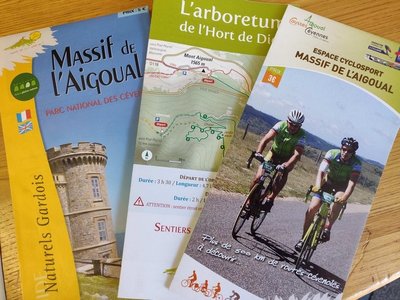
le Pole Nature de l'Aigoual - Béatrice Galzin 
Pôle Nature 4 Saisons
The Pôle Nature 4 Saisons of the Aigoual massif offers outdoor activities in all seasons in the central zone of the Cévennes National Park, overlooked by the legendary summit of Mont Aigoual (1,570 m). Discover our network of trails on foot, on horseback, by bike, or else by mountain-bike or with a donkey, as the fancy takes you!
Children can explore the orienteering circuit or geocaching.
For the sportier among you we have laid out trail running circuits!
Prefer road biking? We have created circuits of varying difficulty levels so you can discover our villages and valleys.
Try not to make any noise! Wildlife enthusiasts can spot mouflons and other animals.
And if you would just like a gentle walk on the massif, the discovery trail “The cliffs of Mont Aigoual” is for you. There are various rest stops over its 4.5 km, with only 150 m in height difference.
We look forward to seeing you on our paths.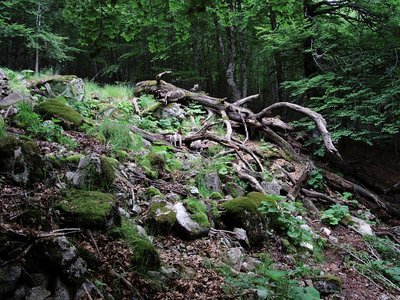
Forêt de l'Aigoual - © Gaël Karczewski 
A site for botanical experiments
Marker 1
L’Hort de Dieu is located at an altitude of 1,300 m and shaped by an extreme climate. This site with its exceptional assets is a favoured study and experimentation zone for botanists. The tree collection is just over 100 years old, and some of the specimens are declining because of old age or else because they are not well-adapted to this mountain range. Today, there are 75 species left of the 140 that have been tested over the past century. To safeguard the interest of this heritage site, the Office National des Forêts and the Cévennes National Park are currently reflecting on renewing the collection.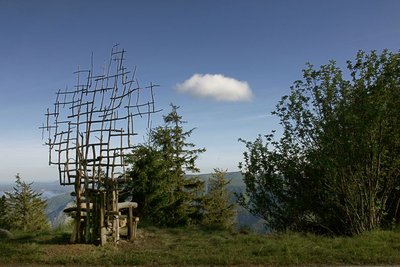
Assise (Marie-Hélène Richard) - © Filature du Mazel 
Seated (Marie-Hélène Richard)
Far from town, paths open the door to new rhythms. Another vision of life and time lets us breathe in the ever-present contemplation, stones, trees and skies. A physical experience of coming face-to-face with nature. A bench made of wood and branches, whose back becomes thinner as it rises towards the sky, as if to turn back into a tree.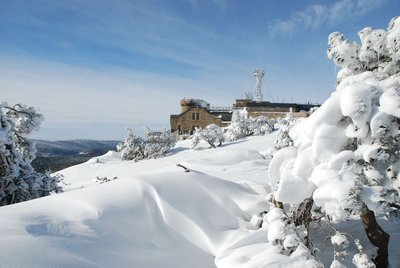
L'Aigoual sous la neige - © Météosite du Mont Aigoual Mont Aigoual weather station
Inaugurated in 1894, this infrastructure is France’s last mountain weather station to be inhabited. Its history is closely linked to the reforestation of Mont Aigoual. It has become a high-performance weather station with an array of modern test instruments, measuring devices for extreme conditions, and a museum/exhibition on meteorology. The 800 sq m exhibition will tell you more about climatology on Mont Aigoual and about meteorology in general.
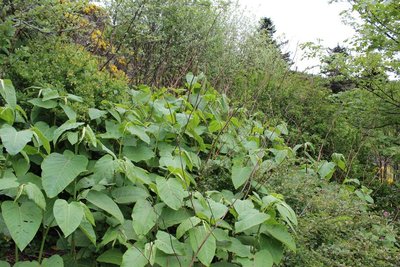
Renouée - © Valère Marsaudon FloraAn invasive species: knotweed (fallopia japonica)
Marker 8
Sakhalin knotweed, just like Japanese knotweed, is an invasive species. That means it is not in its environment of origin and grows at the expense of other species, alongside roads and on the banks of many rivers. A “test zone” project aiming to limit the species is being studied at L'Hort de Dieu, thus continuing the experimental mission of the arboretum. To stop knotweed from proliferating, ripping-up, rhizome destruction and covering- up with tarpaulins are all being tried.
Stèle homage aux botanistes et forestiers - © B. Algoët Botanists' history
Marker 9
The particular nature of this site earned it the name of “God's garden” (Hortus Dei). Since the 16th century, Mont Aigoual has provided botanists with rare species for herbariums and botanical surveys. Some species were also gathered for their medicinal qualities, called “vertus des simples”, a term to be found on a handwritten map of the Cévennes dating from the early 18th century. In 1936, a stele was inaugurated that is dedicated to the memory of the many botanists who contributed to the advancement of the sciences on the L'Hort de Dieu site.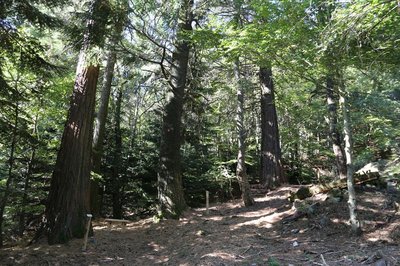
Collection de l'Hort de Dieu - © B. Algoët Acclimatising a plant species
Marker 7
Fabre and Flahault pursued two objectives: studying the way certain forest species adapt to the Cevenol climate and studying plants in their relationship with environmental conditions. Some plant species are better adapted than others to the Cevenol climate. Thus, Mediterranean and Douglas firs do very well, as do almost all the species native to Europe, Asia Minor and the western United States. Species from East Asia and the eastern United States, however, whither away. Through his work, Flahault laid the foundations of phytosociology, the study of how plants arrange themselves into communities as a function of the environmental conditions.
Chalet laboratoire en 2023 - © B. Algoët The Chalet, Charles Flahault's laboratory
Marker 6
“And who knows whether some generous benefactor will not decide one day that our students should have a hospitable roof at L'Hort de Dieu itself? I can see the little house as if it were already built, receiving much sunlight on the Mediterranean side, with its study room on the ground floor and its large fireplace around which scientific problems are discussed late into the night..” (Charles Flahault, 1904)
The Chalet, which was built the following year, made it possible to establish a botanical garden, a high-altitude vegetable plot and a plant nursery nearby. Despite the forest reconquering the surroundings, some of the plants introduced at the time have survived until today: Pyrenean lily, great masterwort, and others.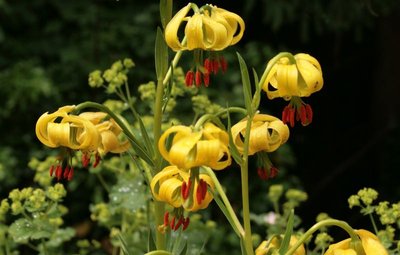
Lis des Pyrénées - © J.-P. Grandmont Alpine garden
Marker 5
This panel shows the legacy of Charles Flahault's experimental work.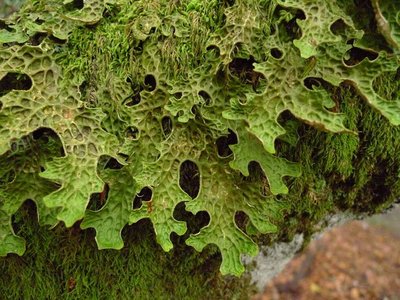
Lobaria pulmonaria - © Mario Klesczewski Did you say “chourradou”?
Marker 4
This remarkable beech is over 200 years old and called chourradou in Occitan, after the sheep that would chourrer (ruminate) and rest under its shady canopy. This kind of tree (large cavity, detached bark and dead wood) is home above all to saproxylic or dead-wood-eating insects and fungi. On another of these old beeches, below the path, you can see a large lichen called lobaria pulmonaria, which needs a lot of water and is highly sensible to atmospheric pollution. It grows very slowly and thus testifies to the ripe old age of this part of the forest.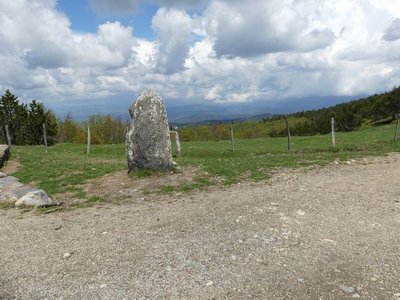
Vue depuis Font de Trépaloup - nathalie.thomas FloraThe evolution of plant life
At the pass stands a schist menhir (standing stone). To the north, in Trépaloup ravine, hewn flint implements bear witness to a human presence in the region since prehistoric times. Palynological analyses (studies of pollen fossilised in peatbogs) have allowed scientists to piece together the plant life on Mont Aigoual from 8,000 to 5,000 BC. Pine predominated, accompanied by birch and hazelnut. Then pine populations gradually diminished. The damp climate warmed up, favouring the spread of oak and hazelnut. Finally, the increased damp and cloud cover at altitude allowed fir and beech to develop. From the end of the first century BC, the substantial percentage of grasses shows that forest had receded in favour of pasture and prairies. This was the start of the great deforestation.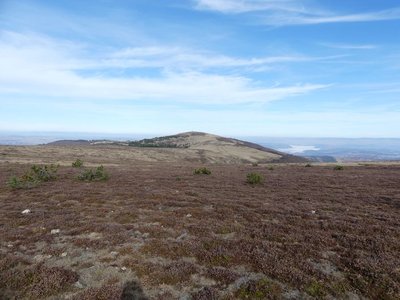
Le Portalet - nathalie.thomas FloraShort-grass prairies and heath on the summit of Mont Aigoual
Here, only species with a short reproductive cycle can settle due to the frequently glacial climate. The heath has been invaded by heather and mountain pine. This zone is barely wooded due to the violent winds and is comparable to subalpine vegetation, consisting of short-grass prairies and heather and blueberry moor. It is sometimes called pseudo-alpine.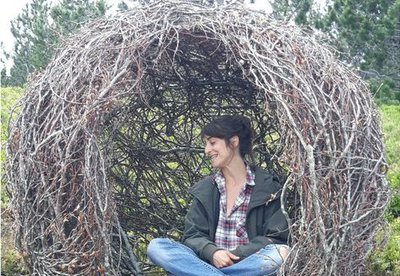
Cellule (Marie Gueydon de Dives) - © Filature du Mazel Cell (Marie Gueydon de Dives)
This artwork, natural in architecture but artificial in execution, represents a passage between the interior and exterior worlds. Posing or opposing while questioning the notions of limit, porousness and opening.
This work encourages you to come inside but feel outside. To be the contemplative eye, the receiving ear, the conscience that objectifies reality.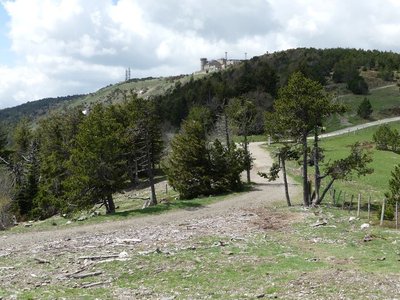
Observatoire de l'Aigoual - nathalie.thomas The meteorological observatory
Inaugurated in 1824, the meteorological observatory was built on the initiative of Georges Fabre, one of the pioneers of the reforestation of Mont Aigoual. His work with the botanist Charles Flahault enabled the creation of the arboretum of L’Hort de Dieu. The first meteorological data were gathered by agents from the French National Water and Forestry Commission. Since 1943, the observatory has been managed by the National Meteorological Office. It is France’s last mountain weather station that is inhabited year-round.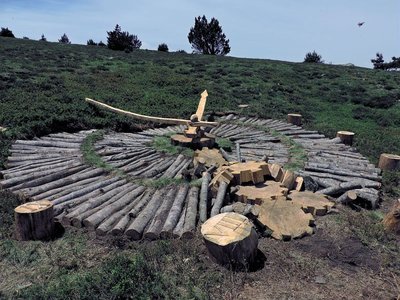
Tempus fugit (Fiona Paterson, Donald Buglass) - © Natacha Maltaverne Tempus Fugit (Fiona Paterson, Donald Buglass)
Time flies, conscience cries, death threatens, heaven invites, hell scolds, and man sleeps. Here, the effects of time and natural elements transform the wood used in the artwork; everything is an endless renewal at the same rate as the passing hours. How much time have we got left before everything is lost and it is too late to repair the damage? Nature will continue on its trajectory and efface the traces of Humanity on Earth.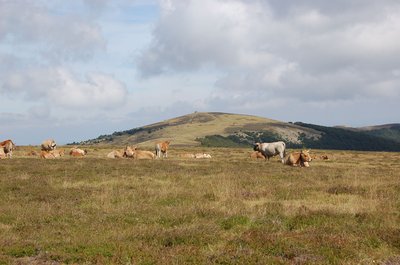
Troupeau au sommet de l'Aigoual - © Nathalie Thomas FloraSummit of Mont Aigoual
At an altitude of 1,565 m, the climate is harsh: weather conditions are the same as they would be at 2,000 m elsewhere, with only four “frost-free” months a year. Winds of above 60 kph blow on 265 days a year, and the average annual temperature is 4.8°C. Trees do not have enough time to complete their life cycle. Local plant formations are those of the montane zone: subalpine short-grass prairies.
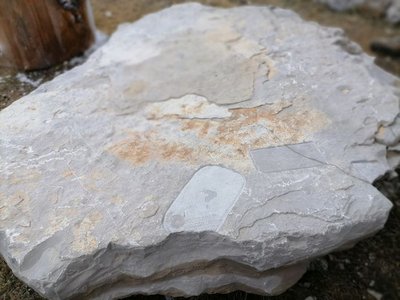
Archéosmart (Marc Limousin) - © Filature du Mazel 
Archeosmart (Marc Limousin)
Smartphone imprints appear on the rocks: fossils of the present that will become mysterious in the future. This carved stone, like the cup-shaped marks and other rock art of the region, discloses history revealed in matter and resonates with Malraux’s phrase: “The future is a present given to us by the past”.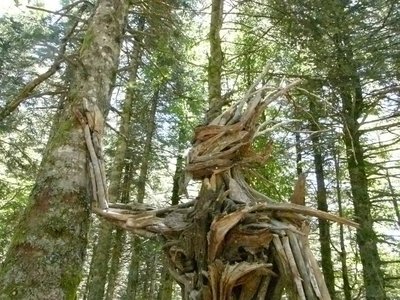
Gardien des bois (Raphaël Daynié) - © Filature du Mazel FloraGuardian of the Woods (Raphaël Daynié)
The Guardian evokes a possible connection, a dream connection, in which humans consider themselves a part of nature, developing in close union with their environment. This Guardian of the Woods overlooking the Aigoual valley was built with natural materials found on site, and gently touches a tree that is still alive.
Description
From Prat-Peyrot :
- Go downhill on the D269 and turn left onto the track closed to motorised vehicles to reach the summit of Mont Aigoual.
- Turn left onto the D118 then the D18 to return to Prat-Peyrot.
- Departure : Prat-Peyrot
- Arrival : Prat-Peyrot
- Towns crossed : Val-d'Aigoual, Meyrueis, and Bassurels
Forecast
Altimetric profile
Recommandations
Only attempt this circuit in good weather.
Before committing yourself to a circuit, ensure that it is suitable for your activity level and ability. Respect traffic laws and other road users; stay in control of your speed and trajectory. Make sure to be seen and travel in single file when in a group. Remember that the weather changes quickly in the mountains. Take enough water. Safe trip!
Information desks

Tourism & national parc'house
Col de la Serreyrède, 30570 Val d'Aigoual
The Maison de l'Aigoual houses the tourism office Mont Aigoual Causses Cévennes and the Maison du Parc national. This visitor centre provides information on and raises awareness of the Cévennes National Park, its sites and events as well as the rules that must be observed in the National Park's central zone.
On site: changing exhibitions, video projections, Festival Nature events and shop Open year-round
Access and parking
From Valleraugue to L’Espérou and the Col de La Serreyrède pass on the D986; then to Prat Peyrot on the D269.
From Meyrueis, to St-Sauveur-Camprieu and the Col de La Serreyrède pass on the D986; from the pass, to Prat Peyrot on the D269.
Parking :
Source

Report a problem or an error
If you have found an error on this page or if you have noticed any problems during your hike, please report them to us here: