
La Clastre chapel
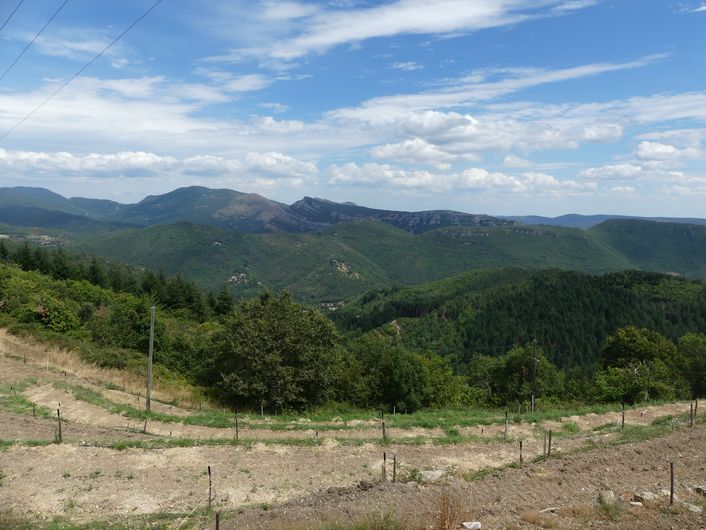
Roquedur
La Clastre chapel
Easy
2h
6,5km
+335m
-335m
Embed this item to access it offline
Beautiful views onto the Hérault and Arre valleys as well as the Ranc de Banes.
3 points of interest
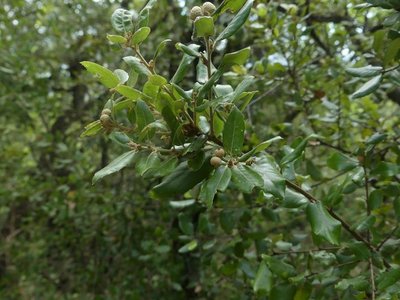
Le chêne vert - Nathalie Thomas  Flora
FloraHolm oak
The holm oak is very present in Cévenol vegetation. It is typical of the Mediterranean slopes of the Cévennes up to 500 m in altitude. The species is well adapted to dry environments due to its small, pointed, glossy leaves. Farmed holm oak groves appear as inextricable thickets where heather and strawberry trees predominate. Their fauna typically includes the Sardinian and Western Orphean warblers. You might also spot the largest lizard species in France, the ocellated lizard.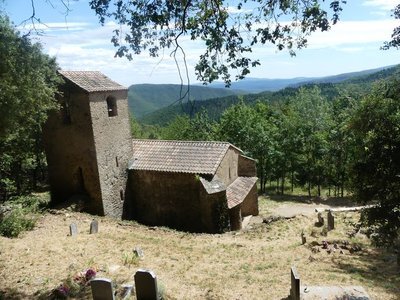
Chapelle de la Clastre - Nathalie Thomas 
La Clastre chapel
In the hamlet of La Clastre, which was a cloister and is now concealed by vegetation, you can see an old well, whose rim is polished from use. The chapel was first mentioned in the 1156 papal bull by Pope Adrian IV. It remained in good condition until 1622, when it was seriously damaged by the troops of the Duke of Rohan. In 1688, a chapel was rebuilt on the ruins, which has not been modified since. A very simple Romanesque building, it has retained two arrow-slit embrasures from the 12th century. The Gard local government has financed the internal and external renovation works.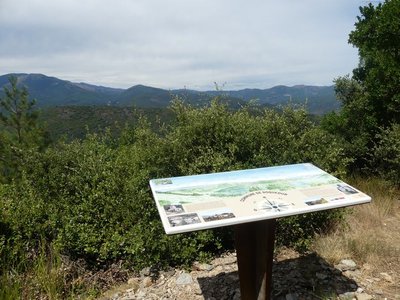
Roquedur le Haut - Nathalie Thomas Roquedur
Until the 13th century, the territory of Roquedur seems to have been a stronghold and an important trade and commerce site belonging to the powerful barony of Hierle, which was part of the Bermond family of Anduze and Sauve. Alongside Montdardier, Esparon and Vissec, Roquedur had one of the most substantial castles in the Cévenol portion of the barony. During the Albigensian (Cathar) Crusade, Pierre VII de Bermond was defeated and placed under house arrest at Roquedur (1240). The fortress was dismantled by Houdard de Villiers. In April 1243, the King of France pardoned Pierre VII, and his barony was returned to him, albeit stripped of much of its land and with the obligation to raze the walls and towers of local fortresses. Pierre VII decided to leave Roquedur and establish the seat of the barony of Hierle “in his castle and town of Aulas”.
(excerpt from the Roquedur leaflet, publ. by the tourism office Cévennes Méridionales – Pays Viganais)
Description
Signposts will guide you all along this route. In the description below, the signposted place names and/or directions are given in bold italics between quotation marks:
Starting from “ROQUEDUR", head towards "Roquedur-Village", then "Les Fabrègues".
Starting from “ROQUEDUR", head towards "Roquedur-Village", then "Les Fabrègues".
- from "Les Fabrègues" turn left towards "Les Traverses" and "Chapelle de La Clastre". From the chapel, retrace your steps.
- Then head via "Le Bois du Duc" and its ruined hamlet, before returning to "ROQUEDUR" via "Roquedur-Village".
- Departure : Roquedur-le-Haut
- Arrival : Roquedur-le-Haut
- Towns crossed : Roquedur
Forecast
Altimetric profile
Recommandations
Make sure your equipment is appropriate for the day’s weather conditions. Take enough water, wear sturdy shoes and put on a hat. Please close all gates and barriers behind you.
Information desks
Tourism office Cévennes and Navacelles, Le Vigan
Maison de pays, place du Marché, BP 21, 30120 Le Vigan
This office is part of the National Park's associated tourist-information network, whose mission is to provide information on, and raise awareness of, the sites and events as well as the rules that must be observed in the National Park's central zone.
Open year-round
Transport
liO is the regional public transport service of the Occitanie/ Pyrénées – Méditerranée region. It facilitates everyone’s movements by prioritising public transport. For more information, https://www.lio-occitanie.fr/
Access and parking
From Le Vigan, take the D 999 towards Le Pont-d'Hérault; 900m after the bridge, turn right onto the D 291 to L'Aumède, Roquedur-le-Haut.
Parking :
Car park as you leave Roquedur-le-Haut, at the information panel.
Source

CC du Pays Viganaishttp://www.cc-paysviganais.fr/

Parc national des Cévenneshttp://www.cevennes-parcnational.fr/
Report a problem or an error
If you have found an error on this page or if you have noticed any problems during your hike, please report them to us here: