
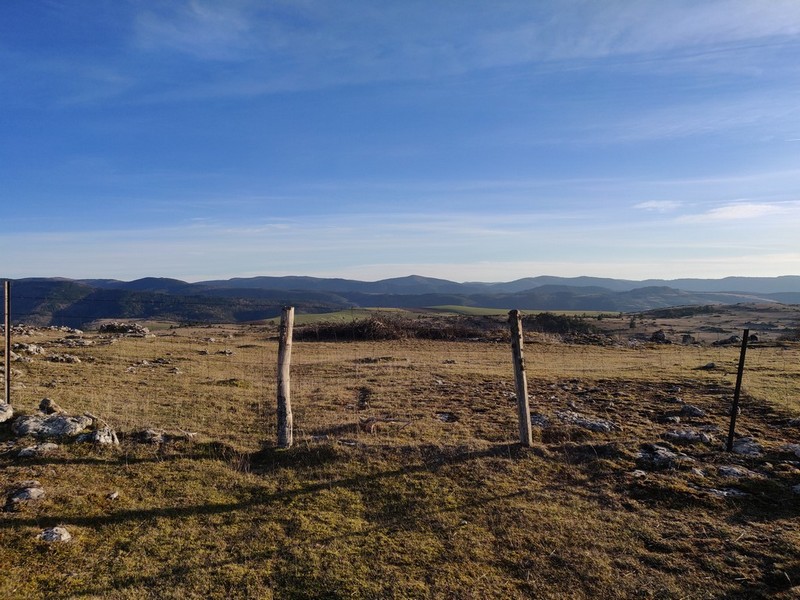
La montée du Causse par Dargilan
Small narrow lanes through varied landscapes. Lanuéjols is an ideal spot for a rest before you take to the road again to return to Meyrueis.
16 points of interest

L'arbre et la vie - Gaël Karczewski 
Forest management
The Mont Aigoual forest.
The wood harvested here comes from a forest that was reforested from the late 19th century onwards, after a period of overgrazing. This forest begins, grows and dies like all living beings. The job of foresters is to manage and support its development while respecting the laws of nature. They harvest trees before they die to make room for young trees. These tree trunks supply an entire economic sector, from the lumberjack to the skidder operator, the saw operator and the carpenter or cabinetmaker. Wood also accompanies you throughout your lives, from your cradle, furniture, woodwork and the wooden frame of your house to your coffin.
L'ancien béal - © A. BOUISSOU / TERRA Ministère de l'Environnement 
Between labour and idleness
Marker 3
Men and women have fashioned the Estate according to their needs and wishes. At Roquedols, crops used to be irrigated with water from the Pauchètes stream. In fact, the path you have just been walking on may have struck you as narrow and stony. It follows a former béal, or small irrigation channel. Much later, ornamental landscaping was laid out, including this beautiful archway – which is built on the vestiges of the wall of the former Protestant cemetery!
Forêt de l'Aigoual entre le col des Ubertes et Roquedols - eddie.balaye 
Produce and protect
Marker 4
Felled trees and branches left on the ground in a protected space? That might seem surprising, but at Roquedols Estate, the forest has always been intended to be productive. In the 19th century, Messrs. Breuil, Dayre and Jouve already exploited the woods of Roquedols intensively. Today, tree fellings are planned with the greatest respect for biodiversity. You are in a living forest, whose appearance evolves by human intervention.
Séquoïa - © Elodie Mazel Forest giants
Marker 5
To contemplate these giants, you need to crane your neck and lift your eyes to the skies! The most remarkable is a giant sequoia originally from California. It was introduced at Roquedols for aesthetic reasons and out of a taste for the exotic. The many silver firs growing around it reveal ambitions of a different kind. In about 1840, the Estate’s owners created a tree nursery so as to be able to grow a large variety of species. The nursery was maintained until the 1980s.
Le Pigeonier - © A. BOUISSOU / TERRA Ministère de l'Environnement Dovecote
Marker 2
The interior layout of the dovecote with its nesting-boxes has been lost. The set-back roof made it possible for the birds to sun themselves in the winter whilst remaining sheltered from the north wind. At Roquedols, as elsewhere, only the nobility had the right to breed pigeons, which were sought-after not only for their flesh but also for their droppings, used as a powerful fertiliser.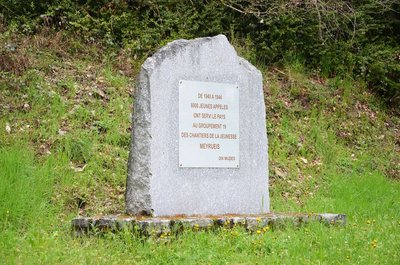
Stèle du chantier n°19, « les jeunes forestiers de Roquedols » - © Dominique Meuret Indoctrinated youth
On the Ferrussac road, the association Anciens des Chantiers de Jeunesse has erected a memorial stone.
The chantiers de jeunesse (youth work sites) were established by the Vichy regime in July 1940 in the French Free Zone to ensure that youths exempted from military service for various reasons received physical and doctrinal training for eight months. About 6,000 youths from Work Site 19, “Roquedols’s Young Foresters”, were spread out in the surroundings of Meyrueis. They carried out forestry work and made charcoal. The work sites were operational from 1940 to 1944.
Coll. Ph. Chambon The Château de Roquedols
Marker 6
A former agricultural estate building, the traditional 14th century farm evolved into a castle in the 16th century. Looking at its quadrilateral shape, you will see that the tower on the left looks different from the one on the right. The shape of the porch before the entrance seems unlike the other parts of this monument. Up until the 20th century, the Château underwent several transformations, but Roquedols Estate has always retained its agricultural purpose. Its successive owners have taken possession of the space in different ways: the Dupont de Bossuges family hosted clandestine Protestant gatherings (18th c.); Madame Dol turned the Estate into a charming residence (late 19th to early 20th c.). During the Second World War, the castle was a refuge for the forestry services and a storage place for artworks. Today, it brings happiness to walkers looking for fresh air!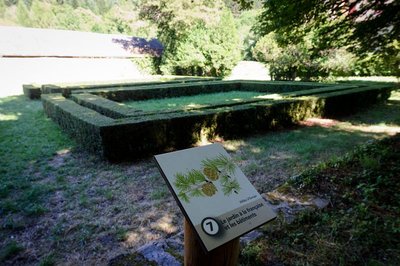
Jardins à la française - © A. BOUISSOU / TERRA Ministère de l'Environnement The formal garden and the buildings
Marker 7
Life was good at Roquedols in the late 19th century! Madame Dol transformed the Estate, embellishing the promenade with a chestnut avenue and formal garden. They might almost make you forget the Estate’s history of agriculture and forestry, except that its buildings – the former farm outbuildings later turned into a sawmill – are such visible reminders of it.
© A. BOUISSOU / TERRA Ministère de l'Environnement Roquedols or literary genius
Marker 2
“It is not a palace. It is a simple castel, a Cévenol castel: the château of a harsh and austere country. Backing onto wooded slopes, it stands in a hollow from where the view extends over the valley downstream.” (Jeannin, 1961). Standing at the top of the dovecote will easily give you a poetical outlook. Roquedols Estate and the forest on Mont Aigoual have inspired many authors. In the 19th century, Fabre d’Olivet invented a troubadour’s chant: in order to recover his castle and marry his betrothed, Ponce de Meyrueis must capture a sword held by terrible brigands. After many incidents, Ponce and Rose are reunited and can live together in love.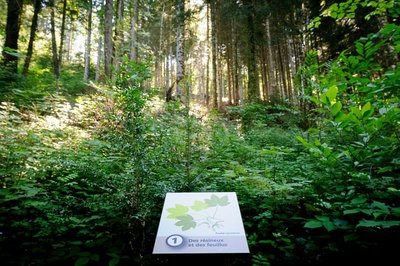
Forêt de Roquedols - © A. BOUISSOU / TERRA Ministère de l'Environnement Of conifers and deciduous trees
Marker 1
In Roquedols forest, firs and beeches grow side by side magnificently. Softwood and hardwood, together? Yes, but the combination is not entirely due to chance. This forest is not a wilderness, but a space cultivated to maintain the diversity of species. At Roquedols, you can see conifers such as fir, larch and spruce as well as deciduous trees: beech, maple and ash. Gaps are made in the forest canopy to give the trees all the light that they need to develop.Attachment
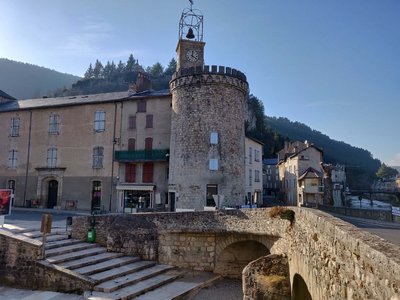
Le centre de Meyrueis et sa tour - Béatrice Galzin 
The village of Meyrueis
The geographical location of Meyrueis is remarkable, nestled between the Aigoual massif, the causse Noir and the causse Méjean. Here the Camin Ferrat crosses the Jonte river. Pilgrims and transhumant flocks of sheep stopped in the village before continuing their journey. Many merchants came to its large fairs. Stroll through the lanes and relive the flourishing past of the belle époque. From the prosperous bourgeois residences to the marketplaces, everything still speaks of the past! Sheep’s wool from the plateaux was woven here, silk was spun. There was intense economic activity. In the 17th century, Meyrueis became a centre for hat-making. By 1860, 17 milliners were busy making hats for Languedoc and Provence, beautiful and exceptionally high-quality hats made from felted wool and silk bourette. Discontinued as of about 1920, this activity left room for tourism, which today animates the village.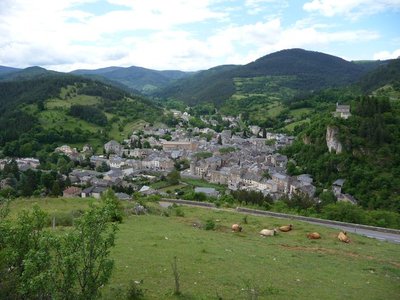
Meyrueis - ©Nathalie Thomas Castle rock
According to a non-verifiable claim from the 17th century, the Roman general Caius Marius had a castrum built on the rock overlooking the village, in 101 BC. However, the first written sources to mention the village date from the 11th c. and refer to the castle, home to the Bermont family. The castle then passed successively into the hands of the Anduze, Roquefeuil and Armagnac families, before falling to Jeanne d’Albret, Queen of Navarre.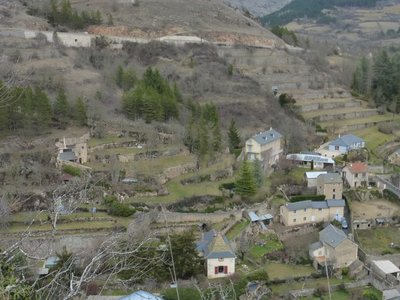
Terrasses sur Meyrueis - © Nathalie Thomas Terrace
Throughout the climb, you will see abandoned former crop terraces. A few grapevines have persisted since local wine-growing came to an end. They bear witness to the fact that the slopes around these hamlets and villages were once cultivated and planted with fruit trees and vines. Terraces like these were the only way for the valley's inhabitants to have flat areas with deep soil suitable for growing.
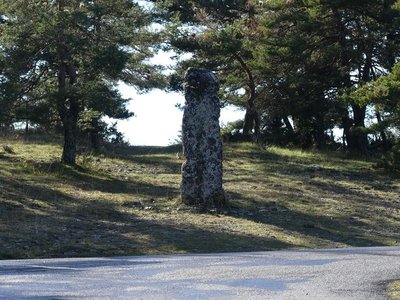
Pierre des Trois Évêques - nathalie.thomas Three Bishops’ Stone
At the crossroads of the D39 and D139 is a standing stone topped by a stone cross. Today the monument symbolises the exact spot where three departments meet: Aveyron, Gard and Lozère. At the times the cross was erected, it indicated the limits of the dioceses of Vabres in the Aveyron, Nîmes in the Gard and Mende in the Lozère.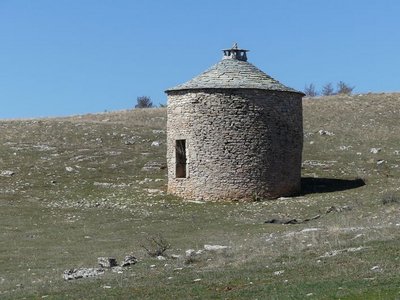
Le pigeonnier des Mazes - Nathalie Thomas The dovecote at Les Mazes
The round building in the middle of the field, on your right as you leave the hamlet, is a dovecote. It is mentioned in 1680. Carrier pigeons were bred there. They were an excellent means of communication in the turbulent 18th century. The efficiency of these uncatchable messengers was such that, as of 1927, the use of carrier pigeons was controlled by the French state. All carrier pigeons were counted, ringed and registered, and all releases were regulated by decree!
Pigeons have an extraordinary sense of orientation and are resilient against long journeys. They will find their way back home with precision, even from several hundreds of kilometres away.
NB. You are on private land. If you decide to approach the dovecote, please make sure the sheep barrier is closed.
Ancienne fromagerie - nathalie.thomas Cheese-making with sheep’s milk
Until the 19th century, sheep were bred for their wool. Their milk was used to produce cheese for the family, which was matured in cellars or caves. It was not until 1880 that the production of blue sheep’s cheese flourished. In 1925, Roquefort became the first cheese to be declared an Appellation d’origine contrôlée (Protected Designation of Origin). Now internationally renowned, Roquefort is exclusively matured in the cellars of the village of the same name.
Description
From Meyrueis, take the D584 towards Sérigas / Dargilan.
- Head for Lanuéjols on the D47c and D47a (there-and-back to Lanuéjols).
- Return to Meyrueis on the D47 and D986.
- Departure : Lanuéjols
- Arrival : Lanuéjols
- Towns crossed : Lanuéjols and Meyrueis
Forecast
Altimetric profile
Recommandations
Before committing yourself to a circuit, ensure that it is suitable for your activity level and ability. Respect traffic laws and other road users; stay in control of your speed and trajectory. Make sure to be seen and travel in single file when in a group. Remember that the weather changes quickly in the mountains. Take enough water. Safe trip !
Information desks

Tourism & national parc'house
Col de la Serreyrède, 30570 Val d'Aigoual
The Maison de l'Aigoual houses the tourism office Mont Aigoual Causses Cévennes and the Maison du Parc national. This visitor centre provides information on and raises awareness of the Cévennes National Park, its sites and events as well as the rules that must be observed in the National Park's central zone.
On site: changing exhibitions, video projections, Festival Nature events and shop Open year-round
Access and parking
From Le Rozier, take the D996 to Meyrueis.
From Florac, to Meyrueis on the D907 and D996, via the Col de Perjuret pass.
Parking :
Source

Report a problem or an error
If you have found an error on this page or if you have noticed any problems during your hike, please report them to us here: