
La vallée de la Salindrenque - Escapades à vélo
This shady circuit is on pleasant small roads through Mediterranean-style forests : umbrella pines, sweet chestnuts, holm oaks. At Soudorgues, the hardest part is over ! Celebrate by having a drink or a coffee in the café in the village centre.
6 points of interest

Granite du rocher de la lune - Béatrice Galzin 
Rocher de la Lune
The Rocher de la Lune (“moon rock”) is a granite block that is typical of the blockfields which are scattered throughout the vale, from the riverbed to the top of the ridges. This granite block is split in two and used to reflect the moon’s silvery rays before it was covered by vegetation.
Oral memory reports that the rock was once painted but that might be a local joke...
Château du Solier dans la verdure - Béatrice Galzin Solier Castle
The downhill section to Lasalle goes past Solier Castle, built in the late 19th century. It has a large machicolated keep with an embrasure for a cannon, mullioned windows and gemel bays. The castles at Algues, Calviac, Cornély, Prades and Soulages are older, having been built from the 15th to the 18th centuries.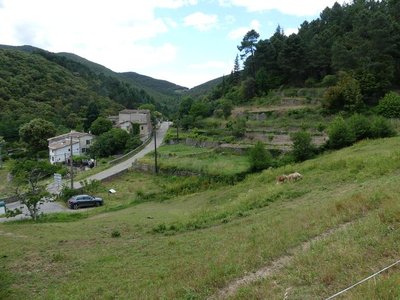
Les Horts et les bancels ou faïsses - Nathalie Thomas Les Horts hamlet
The hamlet got its name from the Latin hortus, meaning garden. The presence of many springs and waterways contributed to the expansion of dry-stone terraces for growing crops (bancels or faïsses). Les Horts had a watermill.

Aiguilles du pin parasol - Béatrice Galzin  Flora
FloraThe stone or umbrella pine
In the distance in the Lasalle valley there is dense, dark green vegetation. The stone or umbrella pine has a very characteristic opened-out shape, which resembles an umbrella from a distance. This conifer is at home especially in the Mediterranean basin. It prefers dry, deep and cool soils. Its bark is reddish and cracked. Its fruit, the pine nut, is often used in pastry cooking.
Cimetière communal - © Nathalie Thomas Cemetery history
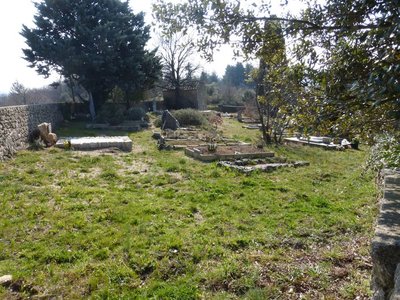
The walk leads you past the village cemetery, which was in fact the Protestant cemetery. Soudorgues also has a Catholic cemetery, another particularity brought about by the turbulent history of the Reformation. Catholic cemeteries did not accept “non-Christians” or “heretic Christians”. There were countless exhumations of Protestant bodies in the 16th century. To put an end to this injustice, the Edict of Nantes ordered that “convenient” cemeteries be built for those who followed the so-called reformed religion. When the Edict was revoked, the order was also dropped. Huguenots had to renounce their religion to be buried in 'family” cemeteries in the countryside. Today, only the owners of these on-site cemeteries still have the right to be buried in them.


Lime kiln
The process of burning limestone to make lime has been used since the Bronze Age. The lime was mixed with sand to make mortar for building houses. Concrete was not known until the early 19th century. Lime is also a powerful antiseptic and was used to disinfect buildings, especially sheepfolds. The kiln operator had to maintain the kiln temperature at 800 to 1,000°C. Plaster was made from gypsum deposits using the same principle.
Description
From Lasalle, take the D153 towards St-Jean du Gard/Ste-Croix de Caderle for about 2 km.
- Turn left on to the D153d, towards Les Cabrols, Les Horts.2
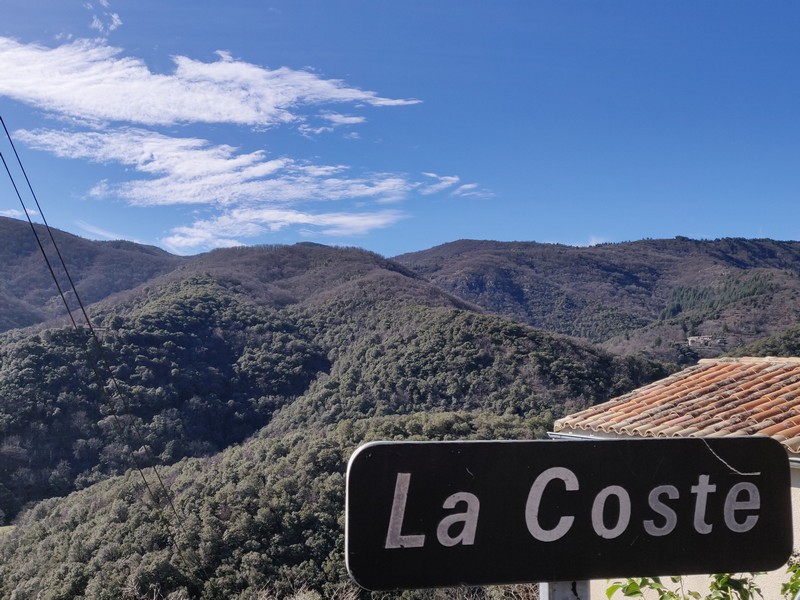
- At Les Horts, turn right onto the D39, then quickly turn left onto the D271 to Soudorgues, La Coste. Continue to the Pont de la Laine bridge.
- Return to the village of Lasalle on the D341a and the D39.
Possibility to start from Soudorgues.
- Departure : Lasalle
- Arrival : Lasalle
- Towns crossed : Lasalle and Soudorgues
Forecast
Altimetric profile
Recommandations
Before committing yourself to a circuit, ensure that it is suitable for your activity level and ability. Respect traffic laws and other road users; stay in control of your speed and trajectory. Make sure to be seen and travel in single file when in a group. Remember that the weather changes quickly in the mountains. Take enough water. Safe trip !
Information desks

Tourism & national parc'house
Col de la Serreyrède, 30570 Val d'Aigoual
The Maison de l'Aigoual houses the tourism office Mont Aigoual Causses Cévennes and the Maison du Parc national. This visitor centre provides information on and raises awareness of the Cévennes National Park, its sites and events as well as the rules that must be observed in the National Park's central zone.
On site: changing exhibitions, video projections, Festival Nature events and shop Open year-round

Tourism office Mont Aigoual Causses Cévennes, Lassale
Centre Viala, rue de la Place, 30460 Lasalle
This office is part of the National Park's associated tourist-information network, whose mission is to provide information on, and raise awareness of, the sites and events as well as the rules that must be observed in the National Park's central zone. : Open year-round
Access and parking
From St-Jean du Gard, take the D907 towards Anduze; at the bridge by the Salindrenque spinning-mill, turn to Lasalle on the D57.
Parking :
Report a problem or an error
If you have found an error on this page or if you have noticed any problems during your hike, please report them to us here: