
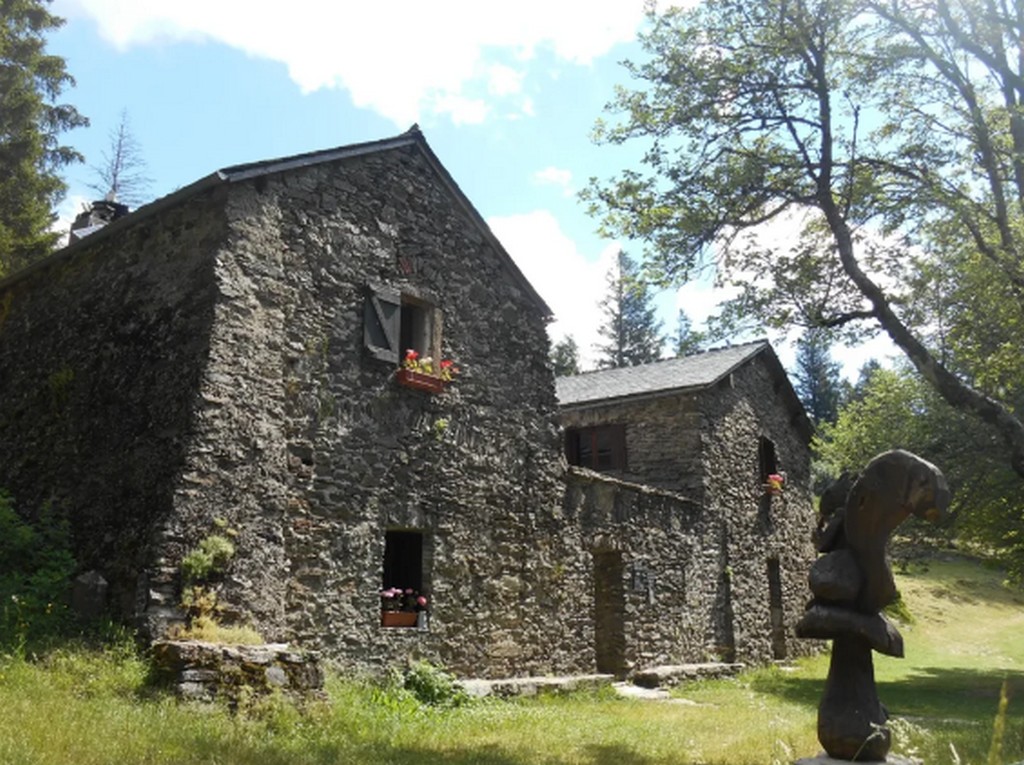
2. From Le Vigan to Mont Aigoual – Day 2
12 points of interest
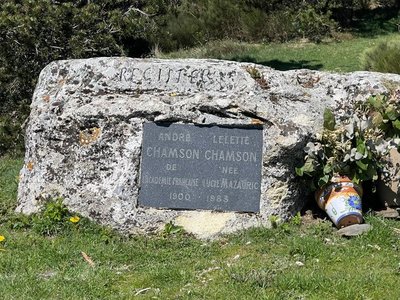

André Chamson (1900-1983)
In his works, André Chamson constructed an imaginary Cévennes park. His writings bear witness to his love for the area and his attachment to his Huguenot ancestors. A nationally renowned writer, he was elected to the Académie française in 1956. His final works see time and death become more powerful than work or human faith.

Mouflon brebis - © Chantal Daquo  Fauna
FaunaWhat is a mouflon?
Marker 1
The mouflon is a ruminant mammal related to the domestic sheep. Its staple diet is herbaceous plants, which it finds in open spaces such as heaths. It also feeds on about a hundred other plants (ferns, mosses, mushrooms, etc.).The horns of the male (ram) are spiral-shaped and grow continuously, which makes it possible to estimate its age. The female (ewe) rarely has horns. The mouflon's life expectancy is around 14 years. Being an excellent climber, it can easily escape to steep areas in case of danger. These rocky zones also help limit the growth of its hooves through wear.
Passage de la transhumance au col de l'Asclié - © Olivier Prohin The origins of the mouflon
Marker 6
L'Abeuradou is located on a draille, a drovers' road for shepherds and their flocks to move between the plains of Languedoc and summer pastures on the southern Massif Central. The name L'Abeuradou indicates that it is a spot where the flocks drink and rest before continuing their long hike. Today's domestic sheep is descended from the mouflon. Since being introduced to the slopes of Mont Aigoual, the mouflon has thus been rubbing shoulders with its cousin, which grazes here in summer. Their cohabitation does not seem to be a problem for the livestock farmers.
Mouflons - © Gaël Karczewski FaunaThe saga of the mouflon
Marker 2
Twenty-three mouflons were introduced to this mountain range in 1954. They roamed the ridge rimmed by heath that you can see in front and to the right of you. Since introduction, the population has slowly grown on the Cevenol slopes. In 1999, the Gard Departmental Hunters' Federation in tandem with the Office National des Forêts, the Cévennes National Park, farmers and hunters took over the management and monitoring of the species. Since then, the population has grown steadily in the Aigoual area, and has recently started to settle other districts as well.
Mouflons - © Régis Descamps Managing the species
Marker 5
The Cévennes National Park is unusual for a national park in that hunting is allowed in its central zone. In the absence of large predators, hunting is considered compatible with maintaining a good natural balance. Local mouflons are subject to a compulsory hunting plan, which estimates the numbers to be culled every year. There is regular monitoring to check population levels. Knowing that a mouflon group grows by about 25% a year, it is possible to calculate the number of animals that can be culled without compromising the future of the herd.
Groupes de femelles - © Gaël Karczewski Head counts
There are two methods for counting mouflons. “Relative abundance indices” estimate variations in the population. In May, observers position themselves in fixed spots at day's end and record the number of animals they see in 20 minutes. Head counts “by combined observation from a hide and from stalking” are used at the end of winter. Observers move through thickets where mouflons shelter. The groups of animals they disturb escape towards fixed observers, who count them. The mouflon population is currently estimated at around 200. Local actors and inhabitants are very involved in the monitoring and counting operations.
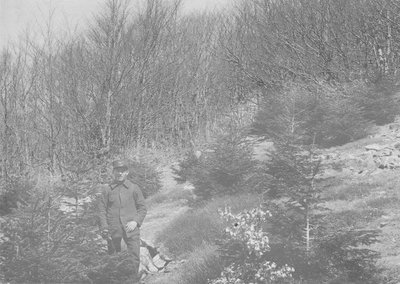
© M Nègre (1923) 
The south-facing slope
Over the centuries, the south-facing slope of Aulas mountain was cleared for pasture, leaving the bedrock bare in places. In the late 19th century, foresters replanted the slope with spruce. These pioneer trees slowly re-established a forest floor and, in their shade, beechnuts germinated. Foresters are now guiding this stand towards a mixed plantation of beech and fir.
lobaria - © Bruno Descaves An ancient forest
Some species, such as the Lobaria pulmonaria lichen, which grows very slowly, are good indicators of a forest’s age. Likewise, some species of herbaceous flora, for instance woodrush, are noticeably more abundant in old forests than in recent forests.
feuille de hêtre - © Emilien Herault  Flora
FloraFrom flower to fruit ...
The beech is a monoecious tree, meaning that female and male flowers are distinct but occur on the same tree. They flower in April and May; insects carry the male reproductive cells (the pollen) to the female cells.
After pollination, the flower produces seeds enclosed in soft-spined husks: beechnuts. Every three to five years, in autumn, an adult beech disperses thousands of seeds.
© Mathieu Baconnet Timber from stumps
Beech trees regenerate very easily; their regrowth is a number of shoots grouped together on the same stump. In the old days, this method (coppicing) was much used to obtain firewood. On the northern slope of Aulas mountain, foresters turned the former coppices into timber plantations on stumps: the new trees with their straight boles were a steady supply of wood for packaging (crates). Since the closure of these companies, the beeches have only been commercialised as firewood.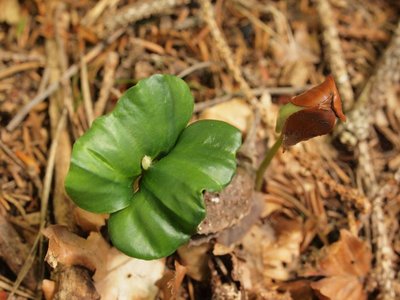
© Philippe Raichaud FloraFrom the seed to the tree
Because most seeds are rich in oils, they are devoured by famished animals in the winter: squirrels, field mice, wild boar, jays, chaffinches… Any seeds still on the ground the following spring can start germinating.
Village de l'Espérou - Béatrice Galzin The village of L’Espérou
The village of L’Espérou lies on the border of Dourbies and Valleraugue local councils. A draille (track for livestock to migrate to summer pastures with their shepherds) crosses the village. As in many villages in the Gard, the two places of worship – one Catholic, the other Protestant – are opposite each other. The village is located in a varied environment that is suitable for outdoor activities and sports.
Description
Signposts will guide you all along this route. In the description below, the signposted place names and/or directions are given in bold italics between quotation marks :
- Starting from "CAP DE COTE", walk to “COL DE MONTALS” via "La Draille", “Abri des Abéouradous”, “Sous la Luzette” and “Montagne d’Aulas” (GR®60 long-distance hiking path).
- At “COL DE MONTALS” continue to “LA HETRAIE” and “Bois de Montals”.
- At “Bois de Montals” take the fork towards “PUEYLONG” (GR®7).
- At “PUEYLONG” continue on the GR®7 to “Le Font des Douzes”, “LES DOUZES” (GR®7, GR®60).
- At “LES DOUZES” walk to “LA HALLE DE L’ESPEROU” via “La Halle” (yellow waymarks).
- Departure : Cap de Côte
- Arrival : L'Espérou
- Towns crossed : Arphy, Val-d'Aigoual, Bréau-Mars, and Dourbies
Forecast
Altimetric profile
Recommandations
Make sure your equipment is appropriate for the day’s weather conditions. Remember that the weather changes quickly in the mountains. Take enough water, wear sturdy shoes and put on a hat.
Information desks

Tourism office Cévennes and Navacelles, Le Vigan
Maison de pays, place du Marché, BP 21, 30120 Le Vigan
This office is part of the National Park's associated tourist-information network, whose mission is to provide information on, and raise awareness of, the sites and events as well as the rules that must be observed in the National Park's central zone.
Open year-round
Source

Report a problem or an error
If you have found an error on this page or if you have noticed any problems during your hike, please report them to us here: